Showing posts with label salmon. Show all posts

Thursday, June 27, 2013

The First Effective Treatment to Prevent Vision Loss, Say Top Scientists

Taking five more bananas a day increases potassium intake, dilates the blood vessels and prevents onset of strokes.

Avocados are also rich in potassium with as much as 1189 mg per serving

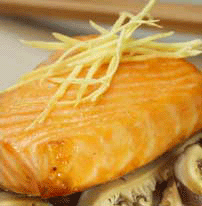
Asthaxanthin helps maintain vision

---------- Forwarded message ----------
From: Underground Health Reporter
Date: Tue, Jun 25, 2013 at 12:31 AM
Subject: The First Effective Treatment to Prevent Vision Loss, Say Top Scientists


Brought to you by Think-Outside-the-Book Publishing, LLC
The First Effective Treatment to
Prevent Vision Loss, Say Top Scientists

In This Issue:

*Did You Know...?
*Featured Article: Discover How You Can Protect Your Precious Sight
*A Word from Our Sponsor:
The Reason You're Tired All the Time

Did You Know...

... that this essential mineral can significantly lower your risk of heart attack and stroke?

     A staggering 98% of Americans are potassium deficient.  If you're not part of the select 2% who gets the recommended daily allowance of this essential mineral and electrolyte, you're at a dramatically higher risk for stroke and heart attack.

     Every cell, tissue and organ in your body depends on potassium.  Potassium delivers oxygen to the brain, maintains the proper functioning of the nervous system, helps your muscles contract, and keeps your heart healthy.

Potassium and Heart Health

Every year 750,000 Americans have a stroke... a stroke that could be prevented with a few dietary and lifestyle adjustments.  A recent study published in the Journal of the American College of Cardiology links potassium to the two biggest killers: Heart attack and stroke.  Researchers discovered that study participants with a 1600 mg per day higher potassium intake had a 21% reduction in stroke risk.

     According to the University of Maryland Medical Center, research suggests that low potassium levels are associated with high blood pressure—which has been shown to be reversed by supplementing with potassium.  Potassium helps lower blood pressure by relaxing blood vessel walls.

     Increasing your potassium intake by 1600 mg a day may cut your risk of stroke by 1/5 and lower your blood pressure, but it is not enough to ensure adequate potassium consumption.

A Potassium-deficient Diet

Potassium was discovered in 1807 as the residual powder left over when a plant is burned to ash and mixed into a pot of water left to evaporate.  Scientists dubbed it "pot ashium."  Prior to the last century, our diets were much more plant based, so much so that we most likely consumed up to 10,000 mg of potassium a day.  The United States Food and Drug Administration (FDA) recommends 4700 mg a day, but nowadays the average American is lucky if they reach 3000 mg.

     Potassium deficiency can manifest as any of the following symptoms:

      Muscle weakness
      Confusion
      Irritability
      Fatigue
      Heart problems
      Chronic diarrhea

     There's no such thing as too much potassium, and without enough, your heart and nervous system completely shut down.  To make sure you're packed with potassium, increase your potassium intake with whole foods for maximum benefit.

     In order to reach your RDA of potassium, you'd need to eat an extra five bananas a day!  Fortunately, you don't have to go overboard on the bananas, which have 422 mg of potassium.  There are many foods with higher concentrations, such as potatoes (751 mg), Swiss chard (961 mg), and avocado (1,189 mg).  Legumes are a rich source of potassium with up to 1,189 mg depending on the bean.  All meats, and certain types of fish, such as salmon, flounder and cod, are rich in potassium.  Dairy products are an easy way to add potassium to your diet. A serving of yogurt delivers a substantial 531 mg of potassium!

     Exercising vigorously, taking diuretics and eating a high sodium diet significantly lower potassium levels.  Experts advise that you can protect your health by doubling the amount of potassium you take in.

= = = = = = = = = = =

Featured Article:
The First Effective Treatment to
Prevent Vision Loss, Say Top Scientists

Discover How You Can Protect Your Precious Sight

     R emarkable new research reveals how 3 antioxidants—lutein, astaxanthin, and zeaxanthin—can protect macular health.  The research makes clear that at the right doses, these nutrients can dramatically curb your chances of age-related vision loss.  The clinical trial proving this was sponsored by the National Institutes of Health (NIH).  It was called the Age-Related Eye Disease Study (AREDS) and was conducted by the National Eye Institute, a branch of the NIH.

Protect Your Vision Starting Now

The good news is that protecting yourself from macular health issues is completely possible if you start early with these simple steps:

Wear sunglasses—don't stare into the sun or bright lights.
Don't smoke or drink alcohol in excess
Eat plenty of leafy green vegetables
Supplement with adequate doses of the antioxidants lutein, astaxanthin, and zeaxanthin

Diet Alone Cannot Prevent Macular Health Issues

Achieving the high levels of nutrients needed to support macular health through diet alone is near impossible.

     A portion of steamed broccoli, a so-called rich source of lutein, actually has less than 1 mg of this vision-saving nutrient.  Vision scientists have recently discovered that you need 20 mg of lutein every day, to really protect your eyesight.  That's 20 times as much as in a serving of broccoli!  And it's even harder to get enough astaxanthin and zeaxanthin from food.

     You can protect yourself from a leading cause of vision loss with 3 simple but powerful nutrients!

Antioxidants Effectively Prevent Vision Loss—But Only in the Right Dosage

In May 2013, the National Eye Institute tested several changes to the original AREDS formulation.  For this study, called AREDS-2, the team added omega-3 fatty acids, as well as the antioxidants lutein and zeaxanthin.  The study showed lutein and zeaxanthin to be safe... effective... and highly promising for supporting macular health.

Buyer Beware: Quality is Key

Many big-name vitamin supplements that claim to protect against vision loss do include those 3 vital ingredients—but they often use far lower doses than those studied in the remarkable AREDS clinical trial.  Expert sources report that some unscrupulous manufacturers use as little as one tenth the amount necessary for benefits!  And shockingly, that's true of supplements specifically labeled as "vision solutions."

     Many formulas that claim to improve vision and support macular health contain only 5 to 10 mg of lutein, despite clear evidence showing that far more is required to be beneficial for eye health.  Additionally, some supplements often offer less than 4 mg of zeaxanthin and no astraxanthin at all.  That last fact is especially concerning, considering some sources suggest astraxanthin is 47 times more powerful than lutein.

Your Body Can't Use What it Can't Digest

It's common sense that in order to benefit from a nutrient, your body has to be able to digest and absorb it.  But unfortunately common sense does not stop supplement companies from using cheap, non-absorbable nutrients.

     The truth is that in addition to including only fractions of the amounts of the potent antioxidants necessary to protect and improve your vision, many companies cut costs further by skimping on subpar ingredients your body can't ever absorb.

     The nutrients pass through you undigested, offering zero benefits.

     High quality lutein is far more bioavailable, meaning you can absorb it through your digestive tract into your bloodstream.  Your eyes are more able to use it and consequently reap far greater benefits.  For AREDS-2, researchers used a specialized, trademarked form of lutein.

No One Should Have to Choose Between Vision and Food

Some commercially available brands do use this trademarked form of lutein, however, those products are shockingly expensive.  No one should have to choose between their vision and feeding their family!  That's why Dr. Michael Cutler, M.D., is so passionate and careful about the supplements he recommends to his patients who are at risk for vision loss.

     Dr. Cutler is a board-certified physician specializing in chronic health conditions, and he is deeply concerned about helping his patients keep their eyesight.  He was outraged when he realized how many of his patients struggled to afford the exorbitant price tags for the right vision supplements.  So Dr. Cutler made a commitment to help his patients to obtain the highest-quality trademarked form of lutein, along with bioavailable astraxanthin and zeaxanthin, at an affordable price.

     Click here to find out what Dr. Cutler discovered as the certified best and affordable way to improve eye health.  Protecting your precious eyesight is easy and affordable when you have the right information.  Start seeing the light at the end of the tunnel today.


If the links above aren't working, just copy & paste the following
website address onto your Internet browser:
http://landing.truehealth.com/products/healthy-vision-complete/TEV_LP03
_0413_SK.asp?SC=TEV1FX39&utm_source=TEV1FX39&utm_medium=outsidemedia&utm_
content=paidmedia&utm_campaign=ultimatevision

= = = = = = = = = = =
A Word from Our Sponsor:

The Reason You're Tired All the Time

     You used to have a ton of energy.  But something changed...

     Now you feel tired all the time, and don't know why.  It's fatigue that goes beyond tired and sleepy...

     You're also suffering from headaches... depression... fuzzy memory... food cravings... and allergies.

     Your doctor says you're fine. Then why do you feel so lousy?

     It's time for answers...

     Scientists have uncovered the overlooked condition behind your unexplained fatigue.

     Click here to find out what it is—and discover the easiest, most effective way to get your energy and your life back.


If the link above isn't working, just copy & paste the following
website address onto your Internet browser:
http://www.advancedbionutritionals.com/MLG/Adrenal/Adrenal-SP-Free-Report
.htm?mkteuid=d0b77191-68f7-40a5-a284-64063cc0ffeb
~~~~~~~~~~
Note:  If this e-mail was forwarded to you and you're not yet an
Underground Health Reporter subscriber, you can receive this
weekly newsletter in your e-mail box by subscribing at
http://bit.ly/uhrnewsletter.
 
© Copyright 2013 Think-Outside-the-Book Publishing, LLC.  All Rights Reserved.

Disclaimer: The entire contents of this e-mail are based upon the research and opinions of the publisher,
unless otherwise noted.  The information in this e-mail is not intended to replace a one-on-one relationship
with a qualified health care professional and is not intended as medical advice. 
It is intended as a sharing of knowledge and information from the research and experience
of the author. You are encouraged to make your own health care decisions based upon your research
and in partnership with a qualified health care professional.

* These statements have not been evaluated by the Food and Drug Administration.
The information in this e-mail is not intended to diagnose, treat, cure or prevent any disease.

If you no longer wish to receive communication from us: Cancel


--
Jorge U. Saguinsin
To "be the best, do your best, expect the best" always

Monday, April 23, 2012

Fwd: WHFoods Weekly Newsletter

I am sharing the newsletter from WHFoods.  It is about Omega 3 fatty acids from fish which is helpful
in counteracting Alzheimer.

Many people are deficient in Omega 3 fatty acids and eating fish is highly recommended

---------- Forwarded message ----------
From: George Mateljan <gmf@mauigateway.com>
Date: Mon, Apr 23, 2012 at 6:20 PM
Subject: WHFoods Weekly Newsletter


Food of the Week

WHFoods
The George Mateljan Foundation, a not-for-profit foundation with no commercial interests or advertising, is a new force for change to help make a healthier you and a healthier world.


April 23, 2012

Eat More Fish
If you are reluctant to include too much fish into your meals because of potential health risks, you are not alone. Dariush Mozaffarian of the Harvard School of Public Health notes that people tend to be more frightened by the threat of a harm than encouraged by the promise of a benefit. .People get confused; they get the wrong message.. And this confusion is for good reason.
For example, take our Food of the Week, Salmon. According to the Food and Drug Administration and the Environmental Protection Agency, salmon is low in mercury and safe even for pregnant women. Yet the Environmental Defense Fund, an advocacy group, recommends that all adults — not just pregnant women — limit wild salmon (except for Alaskan) to one serving per month and farmed salmon to no more than two, because of PCB contamination.
While we are well aware of the risk involved with high mercury content and PCB levels in fish, we should be equally aware that some organizations take only these risks into consideration when making their fish intake recommendations.
Other organizations such as the Institute of Medicine and the Food and Agriculture Organization of the United Nations (working with the World Health Organization FAO/WHO) have taken the approach of weighing the risks against the benefits. Their recommendations were very similar to those of the FDA and EPA:
For pregnant women, they advise eating up to 12 ounces of fish per week, focusing on low-mercury fish, such as salmon, and avoiding the four highest-mercury fish (swordfish, shark, tilefish and king mackerel). According to Mozaffarian, a member of the FAO/WHO panel, "As long as you're not a pregnant woman, the evidence suggests that the balance is always toward net benefit."
The benefits of eating fish are mostly associated with the omega-3 fatty acids found in most fish. Omega-3s have become most well known for reducing the risk of heart disease and, in the case of pregnant women, improved brain development in fetuses and young children. But omega-3s have numerous other benefits, ranging from reduced risk of atrial fibrillation and stroke, promoting bone health and elevating mood. For more read Why should I include fish in my diet?.
I recommend eating low mercury, high omega-3, wild caught fish 2 times per week. I believe a good rule of thumb when it comes to eating more fish is to mix up your species, and include smaller, bottom-of-the-food-chain fish, like sardines. Select fish, such as wild caught Alaskan salmon, which is known to be low in mercury content. Other fish included in this group are Pacific flounder and sole, canned sardines, and anchovies. If pregnant, follow the FDA/EPA guidelines.
Learn a New and Better Way of Cooking Salmon that Tastes Great!
This week I want to share with you how to prepare a great tasting recipe for Quick Broiled Salmon that will be ready to serve in just 7 minutes. Top the salmon with my Mediterranean dressing combined with mustard, ginger, cilantro and a dash of tamari for a taste delight. Learn how quick and easy it is to prepare Salmon with me in this week's video.
Salmon
From both a nutritional and environmental impact perspective, wild fish are far superior to their farm-raised counterparts. FDA statistics on the nutritional content (protein and fat-ratios) of farm-raised versus wild salmon show that wild salmon have a 20% higher protein content and a 20% lower fat content than farm-raised salmon, and much of that added fat in farm-raised fish is pro-inflammatory omega-6 fats, which farmed fish contain in much higher amounts than wild fish.
What You Should Know About Salmon
With so much focus on the amazing omega-3 benefits of salmon, other unique health benefits from salmon haven.t had their fair share of time in the spotlight. One fascinating new area of health benefits involves the protein and amino acid content of salmon ... The Latest News About Salmon.
Best Food Sources for:
Enjoy your Healthiest Way of Eating this week!
George
P.S. Remember you can now find us on Facebook!

weekly newsletter
Forwarded from a friend? Sign up for your own copy of the Weekly Newsletter and Daily Healthy Tip and Recipe.
We sincerely apologize for two broken links in the Daily Tip "Which seeds and nuts help digestion and "keep you regular" in a natural way?" found in our email of April 13, 2012. The correct links are: Does soaking nuts increas their digestibility? and Where does the digestion of food occur?.
Check Out What's New On the WHFoods Website and Find the latest and most up-to-date information on Soy sauce, Tofu and Tempeh, Soybeans.
Food of the Week . . . Salmon
Did you know that researchers believe that about 60% of Americans are deficient in omega-3 fatty acids, and about 20% have so little that tests cannot even detect any in their blood? The list of benefits derived from omega-3s is long and impressive, ranging from improving cholesterol levels and reducing the risk of stroke to acting as anti-inflammatory agents and improving bone density. Recent studies are finding increased intake of omega-3 fatty acids may also help decrease the risk of Alzheimer.s disease. As study after study reveals the importance of these essential fatty acids, we also are becoming increasingly aware that they are not readily available in many of the foods that we eat. Cold water fish, such as salmon, are some of the best sources. Not only does salmon provide a host of healthy benefits, it tastes great! Late spring is the beginning of the salmon season. Different species of wild salmon will become available from now through the fall of the year, so be sure to enjoy them while they are in season.Read More
If you have any questions about today's Newsletter Ask George Your Question
Quick Broiled Salmon with Mustard and Ginger

Recipe of the Week

view recipe ...
The Food Tip of the Week: The Best Way to Store Salmon
Here is the Daily Tip for this week: Why is farmed salmon not your best choice for salmon? The largest survey yet of pollutants in salmon, reported in the January 9, 2004 issue of Science, clearly indicates that because of the feed they receive, farmed fish have much higher levels of carcinogenic pesticides (specifically polychlorinated biphenyls or PCBs, and two other organochlorine compounds, dieldrin and toxaphene) than wild caught salmon ...
A big Thank You to you all! This book is amazing and has helped me transition my lifestyle into something much healthier and more wonderful. This is my go-to guide; I love it!! - Kristyn

Circulation: over 90,000 Copyright © 2012 The George Mateljan Foundation, All Rights Reserved

George Mateljan Foundation, PO Box 25801, Seattle, Washington 98165

To unsubscribe or change subscriber options visit:
http://www.aweber.com/z/r/?LKzMrGyMtKyM7MwcLAwctEa0jCyMrIxMDMw=


--
Jorge U. Saguinsin
Angono, Rizal
nuideashare
cheapcures

HOLY GARDENS MEMORIAL